

close
Choose Your Site
Global
Social Media
Views: 0 Author: Site Editor Publish Time: 2026-03-11 Origin: Site


In fluid control systems, selecting the right valve type directly affects reliability, efficiency, and long-term maintenance costs. Among the most commonly compared options are Ball Valve and gate valve designs. While both are widely used for on/off control, they serve different operational priorities. In our daily work with industrial users, contractors, and system designers, one of the most frequent questions is: When should you use a ball valve instead of a gate valve?
The answer depends on several factors, including operating frequency, sealing requirements, pressure conditions, speed of operation, maintenance expectations, and media characteristics. Understanding the differences between these two valve types helps engineers and buyers avoid over-engineering, reduce failure risk, and optimize system performance. A ball valve is often chosen when fast shut-off, tight sealing, and operational simplicity are critical, while gate valves are typically used where minimal flow restriction is required in fully open conditions. Knowing when each design performs best allows more efficient system design.
A ball valve uses a rotating ball with a bore to control flow. Turning the handle 90 degrees opens or closes the valve quickly.
A gate valve uses a sliding gate that moves vertically to stop or allow flow.
Feature | Ball Valve | Gate Valve |
Operation | Quarter-turn | Multi-turn |
Shut-off speed | Fast | Slow |
Sealing | Tight | Moderate |
Flow control | Not ideal for throttling | Not ideal for throttling |
Maintenance | Lower | Higher |
These structural differences explain most application decisions.
Ball valves are preferred in situations where immediate shut-off is critical to system safety or process control. Because a ball valve operates using a simple quarter-turn motion, the flow path can be fully opened or completely closed in a very short time. This rapid response is particularly valuable in dynamic systems where delays could lead to equipment damage, product loss, or safety hazards.
Typical scenarios include:
Emergency isolation during abnormal conditions
Equipment protection when pressure or flow exceeds limits
Process switching in batch production lines
Safety-critical lines handling gas, chemicals, or flammable media
Quarter-turn operation allows operators or automated systems to react instantly. In contrast, gate valves require multiple turns to move the gate through its full travel, which increases response time. In emergency situations, this difference can be significant.
Ball valves are widely recognized for their reliable sealing performance. The spherical ball makes full contact with resilient seats, enabling bubble-tight shut-off when properly specified. This sealing capability is one of the main reasons ball valves are selected for isolation applications.
Applications where sealing is especially important include:
Gas distribution systems
Chemical handling processes
Water supply isolation points
Compressed air networks
Because the sealing surfaces in a ball valve remain protected inside the body, wear is often more predictable. Gate valves can also achieve effective sealing, but debris accumulation, seat wear, or improper operation may reduce sealing performance over time. For systems where leakage cannot be tolerated, ball valves often provide a more reliable solution.
Ball valves perform particularly well in applications requiring repeated opening and closing. Their simple rotational motion reduces mechanical stress on internal components and minimizes wear on the stem and sealing surfaces.
Reasons ball valves are suitable for frequent operation:
Simple motion reduces friction and wear
Lower risk of stem damage compared with multi-turn valves
Faster operation improves workflow efficiency
Reduced maintenance frequency over the valve lifecycle
In contrast, gate valves are typically better suited for applications where they remain in one position for long periods. Repeated operation can accelerate wear on gate mechanisms and increase maintenance requirements. Therefore, systems involving routine isolation, process switching, or operator interaction often benefit from ball valve selection.
Installation space is a practical factor that strongly influences valve selection. Ball valves are often more compact than gate valves, making them easier to integrate into tight piping layouts, equipment assemblies, and modular skid systems.
Advantages include:
Shorter face-to-face installation length
Easier integration with actuators and accessories
Simplified piping layout and reduced structural complexity
Better suitability for packaged equipment and modular systems
In modern industrial designs where equipment density is increasing, compact components provide clear advantages. Ball valves support streamlined system architecture while maintaining reliable shut-off performance.
Automation is another area where ball valves offer clear benefits. Their quarter-turn mechanism allows straightforward actuator integration, whether pneumatic, electric, or hydraulic. This simplicity reduces control complexity and improves response speed.
Automation benefits include:
Faster control response for process regulation
Simpler actuator design compared with multi-turn valves
Lower energy consumption during operation
Reliable repeatability for automated sequences
Gate valves can also be automated, but the actuator systems are typically larger and more complex due to the linear multi-turn motion required. For systems prioritizing automation efficiency, ball valves are often the preferred choice.
Pressure drop considerations sometimes influence valve selection. Full-port ball valves provide minimal restriction because the bore diameter matches the pipeline, allowing smooth flow when fully open. However, reduced-port ball valves may introduce some flow resistance.
Gate valves generally offer very low resistance when fully open because the gate moves completely out of the flow path. Therefore, the decision depends on system priorities.
Guidelines for selection:
Choose ball valves when shut-off performance, sealing reliability, and operational speed are priorities
Choose gate valves when uninterrupted flow and minimal pressure loss are the primary objectives
In many modern systems, the slight pressure drop associated with ball valves is acceptable given the advantages in sealing, automation, and operational reliability.
Ball valves perform well across many media types.
Common applications:
Water
Oil
Gas
Chemicals
Slurries (depending on design)
Gate valves may struggle in media containing debris because gate movement can be obstructed.
Ball valves generally require less maintenance due to simpler internal movement.
Lifecycle advantages:
Fewer moving parts exposed to wear
Less stem travel
Reduced leakage risk
Easier replacement
Gate valves may require periodic adjustment.
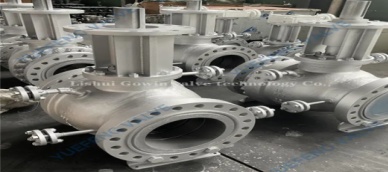
Ball valves provide clear visual indication of open/closed status based on handle position.
Safety benefits:
Quick verification
Faster emergency operation
Reduced operator error
Improved lockout capability
This is valuable in industrial environments.
Initial cost differences vary by size and material.
However, operational efficiency often favors ball valves when:
Frequent operation occurs
Downtime must be minimized
Automation is planned
Sealing reliability is critical
Total lifecycle cost becomes the key factor.
Balanced decision making is important.
Gate valves may be preferred when:
Large diameter pipelines require minimal restriction
Valves remain open most of the time
Flow turbulence must be minimized
Very high temperature environments exist
Each valve type has a clear role.
Industry | Ball Valve Advantage |
Oil & gas | Fast isolation |
Water treatment | Reliable shut-off |
Manufacturing | Frequent operation |
HVAC | Compact installation |
Chemical processing | Tight sealing |
Application context determines selection.
Using gate valves for frequent operation
Choosing ball valves for throttling without proper design
Ignoring sealing requirements
Underestimating automation needs
Selecting based only on initial cost
Understanding use case prevents these mistakes.
In practice, the decision between ball valve and gate valve should be based on how the system operates rather than tradition. Many modern systems prioritize responsiveness, automation compatibility, and sealing reliability — areas where ball valves offer clear advantages.
We often support customers by reviewing operating frequency, media type, pressure conditions, and maintenance expectations before recommending valve types. This approach ensures that the selected valve aligns with real operational requirements rather than theoretical specifications.
Understanding when you should use a ball valve instead of a gate valve comes down to operational priorities. Ball valves are typically the better choice when fast shut-off, tight sealing, compact design, automation compatibility, and frequent operation are required. Their quarter-turn mechanism simplifies control and improves reliability across many industrial applications.
Gate valves continue to play an important role in large pipelines and systems where valves remain mostly open and minimal flow resistance is critical. However, as systems become more automated and dynamic, ball valves are increasingly selected for their responsiveness and lifecycle advantages.
From our perspective, effective valve selection begins with understanding real operating conditions. By evaluating performance requirements, media characteristics, and maintenance goals, it becomes easier to determine whether a ball valve provides the right solution. If you would like to explore valve options, technical specifications, or application guidance, you can learn more by visiting www.gwvvalve.com and connecting with our team.
1. When is a Ball Valve better than a gate valve?
When fast shut-off, tight sealing, and frequent operation are required.
2. Can a Ball Valve replace a gate valve?
In many applications yes, especially for isolation and automation scenarios.
3. Are Ball Valves suitable for high-pressure systems?
Yes, when properly designed and rated for pressure requirements.
4. Why are Ball Valves used more in modern systems?
Because they offer faster operation, better sealing, and easier automation.


