

close
Choose Your Site
Global
Social Media
Views: 0 Author: Site Editor Publish Time: 2026-04-23 Origin: Site


Engineers and facility managers universally rely on Butterfly Valve installations across myriad industries. Their incredibly compact footprint and low acquisition cost make them ubiquitous in industrial fluid control networks. However, their specific internal mechanics dictate extremely strict application boundaries. Selecting the wrong valve configuration often results in disastrous operational failures. Mismatching offset types or ignoring fluid dynamics leads to premature seal failure, system cavitation, or catastrophic line leaks. These engineering mistakes drain maintenance budgets and cause severe unplanned downtime.
We will break down the exact quarter-turn mechanics driving these systems. You will learn to evaluate structural variations from concentric to triple-offset designs. Ultimately, this guide provides a precise decision-stage framework to help you specify the right industrial Butterfly Valve for high-stakes fluid control environments.
Mechanical Reality: Butterfly valves operate on a 90-degree quarter-turn principle, providing rapid actuation, but permanently leave the disc in the flow path, causing an unavoidable pressure drop.
Seal Evolution: Moving from concentric to triple-offset designs drastically reduces friction, allowing for high-pressure, extreme-temperature use (including bubble-tight shut-off).
Maintenance Trade-offs: Connection types directly impact downtime; Wafer styles require full system shutdowns for maintenance, while Lug styles allow for single-sided line disconnection.
Strict Limitations: They are generally unsuitable for lines requiring "pigging" (internal cleaning) or fluids with suspended solid particles that can jam the disc mechanism.
The mechanical simplicity of these valves makes them highly reliable. They rely on a central disc mounted on a rotating stem. This configuration transitions from a fully open state to a fully closed state through a precise 90-degree rotation. Because they require only a quarter-turn, they actuate much faster than multi-turn gate or globe valves.
To understand the mechanical sequence, consider these operating phases:
Fully Closed (0 degrees): The disc sits perfectly perpendicular to the fluid flow. The edges press tightly against the seat, blocking all fluid passage.
Modulating Phase (1 to 89 degrees): The stem rotates, angling the disc. Fluid begins bypassing the edges. As the angle increases, the flow volume rises non-linearly.
Fully Open (90 degrees): The disc aligns parallel to the fluid flow. It exposes the maximum possible cross-sectional area of the pipe, allowing peak flow rates.
You must account for the structural reality of the in-line disc. Unlike ball valves, which offer an entirely unobstructed path when open, a butterfly disc permanently remains inside the fluid path. Even at 100% open, the disc profile blocks a portion of the pipe.
This physical obstruction generates continuous turbulence downstream. It also creates a measurable, unavoidable pressure drop. Engineers must calculate this pressure loss when designing pumping systems. Failing to account for the disc's resistance often leads to undersized pumps and inefficient fluid delivery across the network.
Fluid dynamics heavily influence valve performance during throttling, which means operating in partially open states. When you hold the disc at intermediate angles, the fluid hits the disc asymmetrically. One side of the disc angles into the oncoming flow, while the other side angles away.
This asymmetry generates intense vortex shedding and creates dynamic hydrodynamic torque. The fluid actively tries to twist the disc closed. Torque requirements actually peak at these intermediate angles rather than at the fully open or closed positions. You must size actuators properly to overcome this peak dynamic torque. If you under-size the actuator, the valve mechanism will stall, leading to total loss of flow control.
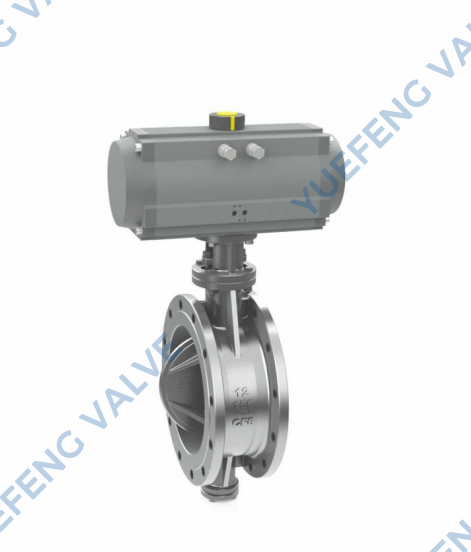
Valve manufacturers have evolved seal designs to overcome friction and handle extreme conditions. We categorize these solutions by their offset geometry.
Concentric designs represent the most basic configuration. The stem passes directly through the centerline of the disc, and the disc sits exactly in the center of the pipe bore. This design relies entirely on the elasticity of a thick rubber seat to create a seal.
Because the stem is centered, the disc rubs against the rubber seat for the final 85 degrees of closure. This continuous friction causes gradual wear. Concentric valves fit best in low-pressure utility water systems and standard HVAC applications. They offer the lowest initial acquisition cost, making them ideal for budget-conscious, low-intensity projects.
High-performance double offset designs move the stem to minimize friction. The manufacturer shifts the stem behind the disc center and pushes it slightly to one side. This dual-axis shift creates a cam-like action during operation.
As the valve closes, the cam action keeps the disc entirely off the seat until the final 1 to 3 degrees of rotation. This massive reduction in rubbing significantly extends the seal's lifespan. Double offset configurations fit best in higher pressure networks. They easily handle pressures up to 1,480 psi. We recommend them for moderate industrial applications where durability and longer maintenance intervals remain critical.
The Triple Offset Valve (TOV) introduces a third geometric change: a conical seating angle. The edge of the disc and the internal seat are machined into matching angled cones. The disc acts like a wedge driving into the seat.
This conical geometry completely eliminates all rubbing and friction until the final millisecond of closure. TOVs utilize metal-to-metal seals instead of vulnerable elastomers. They fit best in mission-critical environments. A quality TOV achieves API 598 bubble-tight shut-off, meaning zero leakage. They handle extreme temperature swings, performing flawlessly in 760°C petroleum refining systems or sub-zero cryogenic LNG terminals.
Design Type | Friction Profile | Seal Material | Best Application Fit |
|---|---|---|---|
Concentric | High friction (rubbing over ~85°) | Elastomer (Rubber) | Low-pressure utility water, HVAC systems. |
Double Offset | Low friction (rubbing over ~1-3°) | PTFE / High-grade polymers | Moderate industrial processes, up to 1,480 psi. |
Triple Offset (TOV) | Zero friction (wedge closure) | Laminated Metal / Solid Metal | Extreme temperatures (760°C), cryogenic systems. |
Choosing the correct outer body style dictates your future maintenance capabilities. Manufacturers offer two primary body configurations: Wafer and Lug.
Wafer Style: You clamp a Wafer body directly between two pipe flanges using long bolts that span across the entire valve. This design uses less metal, making it highly cost-effective and lightweight. However, it carries a severe operational risk. It creates a single point of failure in your piping network. If you need to remove the valve or inspect the seal, you must fully drain the line and shut down the entire upstream and downstream system.
Lug Style: Lug bodies feature cast threaded inserts surrounding the perimeter. You use two independent sets of bolts to connect the upstream flange and the downstream flange directly to the valve body. This advantage enables end-of-line maintenance. You can safely unbolt and remove the downstream piping while the valve remains securely bolted to the pressurized upstream line. Caveat to watch out for: When utilizing a Lug style in dead-end service without a downstream flange, its maximum pressure rating often drops by 50%.
You must pair the valve body with the correct actuator to ensure process safety and network scalability.
Pneumatic Actuators: These utilize compressed air to drive the stem. They offer extremely fast response times, often snapping closed in fractions of a second. This speed makes them ideal for emergency shut-off valves (ESDV). Because they do not rely on electricity, they inherently suit ATEX-rated and hazardous explosive environments.
Electric Actuators: Electric motors provide slower, highly controlled operation. This deliberate speed prevents dangerous water hammer effects in liquid lines. They offer exceptional precision for automated modulation control. Furthermore, electric actuators draw zero power when they remain stationary, lowering long-term energy costs.
Manual Actuators: Hand-operated levers work fine for very small pipes. However, for larger diameters, you must specify gear-operated manual handwheels. The gearbox multiplies human torque, making it easy to close massive valves. The gearing also acts as a safety brake, preventing the fluid's hydrodynamic torque from violently back-driving the handle.
Despite their versatility, certain applications strictly disqualify quarter-turn disc valves. Recognizing these limits prevents catastrophic system failures.
Many heavy industries, especially oil and gas, require pipeline "pigging." A pig is a solid mechanical device pushed through the pipe to scrape the walls, clean out debris, or separate different product batches. You cannot utilize these valves in any pipeline network requiring pigging. Even when fully open to 90 degrees, the central disc and stem permanently obstruct the bore. A pig will crash directly into the disc, destroying both the pipeline cleaning tool and the valve stem.
We issue a strong evidence-based warning against using these configurations for heavy muds, slurries, or abrasive particulate fluids. The disc hinges on bearings located at the top and bottom of the pipe interior. When you process fluids containing suspended solids, abrasive particles inevitably migrate into the stem cavities and bearing housings.
Solids rapidly accumulate in the bottom seal cavity. When you attempt to close the valve, the disc pinches these trapped particles against the seat. This prevents tight shut-off and permanently gouges the sealing material. For slurries, engineers should specify knife gate valves instead.
Prolonged throttling of high-velocity fluids induces severe localized pressure drops across the disc edges. When you keep the valve half-open in a high-pressure line, the sudden acceleration of fluid past the disc causes the local pressure to plummet below the liquid's vapor pressure.
This triggers cavitation. The liquid temporarily boils into tiny vapor bubbles, which immediately collapse with explosive force as pressure recovers downstream. These microscopic shockwaves aggressively erode the metal disc and seat. Over time, cavitation looks like someone took a shotgun to the metal components, completely destroying the valve's integrity.
Base your internal material selection entirely on fluid chemistry and system temperature limits. Mismatching the seat material to the fluid guarantees rapid degradation.
Material Selection Chart
Seat / Liner Material | Maximum Temperature | Best Suited Media | Avoid Using With |
|---|---|---|---|
EPDM | 120°C (248°F) | Drinking water, HVAC, mild alkalines. | Oils, petroleum-based fluids. |
NBR (Buna-N) | 85°C - 110°C | Oils, compressed air, fuels. | Strong acids, UV exposure. |
PTFE / Silicone | 200°C (392°F) | Highly corrosive agents, chemicals. | Abrasive slurries. |
Solid Metal (TOV) | 760°C+ | Superheated steam, cryogenic fluids. | Utility water (overkill/costly). |
Procurement teams must frame decisions around the Total Cost of Ownership (TCO), rather than just the initial sticker price. A quarter-turn valve inherently requires less initial structural support due to its lighter weight and compact face-to-face dimensions compared to gate valves.
However, buyers must actively model the lifecycle costs. You must calculate the exact cost of actuator sizing. An undersized actuator might save money upfront but will fail dynamically during peak flow. You must also budget for seat replacement intervals. Finally, quantify potential maintenance downtime based on the Wafer versus Lug choice. The extra upfront cost of a Lug body pays for itself the first time you perform end-of-line maintenance without shutting down the main header.
Ensure your automated procurement specifications clearly define the required failure mode based on system safety compliance. If the facility loses plant power or compressed air, what must the valve do?
Specify "Fail-Closed" configurations for chemical feed lines or hazardous gas pipes to stop the flow during an emergency. Specify "Fail-Open" configurations for cooling water lines to ensure emergency heat dissipation continues even during total power loss. The actuator spring mechanism governs this safety response, and you must verify it prior to installation.
Understanding internal fluid mechanics and structural geometry ensures successful piping system designs. You must align the valve's offset configuration with your specific process demands to guarantee longevity and safety.
Summarize the shortlisting logic: Choose concentric, resilient-seated models for basic low-pressure utilities. Step up to double offset designs for standard industrial process isolation. Always specify Triple Offset Valves (TOV) for extreme temperatures and mission-critical high-pressure environments.
Prioritize maintenance access: Invest in Lug-style bodies for critical junctions to allow safe, localized maintenance without executing a facility-wide shutdown.
Model fluid behavior: Prioritize exact fluid profiling over initial unit cost. Avoid using these valves for abrasive slurries or systems requiring pigging.
Size actuators dynamically: Always calculate mid-stroke hydrodynamic torque. Sizing actuators for peak dynamic loads secures long-term reliability and prevents catastrophic stalling.
A: We generally discourage inverted installations. Installing the valve upside down significantly increases fluid turbulence. It also compromises the stem seal integrity over time. Furthermore, dirt, sediment, and debris naturally settle into the downward-facing actuator neck. This accumulation jams the rotating mechanism and drastically shortens the actuator's lifespan. Always follow manufacturer orientation guidelines, favoring horizontal or upright vertical stem positions.
A: Many resilient-seated concentric valves are fully bidirectional. They handle flow equally well from either side. However, high-performance double offset and triple offset valves typically have a preferred flow direction. Manufacturers mark this preferred direction with a prominent arrow cast onto the valve body. Following this directional arrow allows fluid pressure to assist the sealing mechanism, ensuring maximum leak tightness under heavy loads.
A: Yes, they function well for basic flow regulation, but you must restrict throttling strictly to the 30° to 80° open range. Operating below 30° creates severe localized pressure drops. This induces cavitation, which rapidly erodes the metal disc. Operating too close to fully open offers minimal control while generating excessive dynamic torque. Always size the valve so your normal flow rate falls within this safe mid-range.


