

close
Choose Your Site
Global
Social Media
Views: 0 Author: Site Editor Publish Time: 2026-04-27 Origin: Site


Pneumatic actuators are often considered a legacy technology in an increasingly digital world. Yet, their unmatched power-to-weight ratio and inherent safety keep them firmly at the core of modern industrial automation. Engineers and procurement teams cannot simply ask what these devices do. You need to rigorously evaluate whether pneumatic, electric, or hydraulic solutions offer the best Total Cost of Ownership and reliability for your specific operational environment. Choosing poorly inevitably leads to costly downtime, excessive maintenance, and tremendous energy waste. This guide moves far beyond basic mechanical concepts to provide highly actionable engineering insights. We cover system-level control loop integration, vital torque sizing criteria, and essential compliance standards. By the end of this article, you will precisely understand how to procure the right automation components for your facility with absolute confidence.
Speed & Safety: Pneumatic systems offer rapid cycle times and are intrinsically safe for explosion-risk environments (e.g., Oil & Gas).
System Integration: Modern setups link Programmable Logic Controllers (PLCs) with I/P converters (4-20mA to 3-15 psi) for precise automated actuation.
Selection Priority: Proper sizing requires mapping breakaway, running, and end torque, alongside strict adherence to ISO 5211 and NAMUR interface standards.
Cost Reality: While initial CapEx is lower than electric actuators, long-term OpEx is heavily dependent on the efficiency of the facility's compressed air infrastructure.
To understand performance capabilities, we must look at basic physics. Pneumatic energy relies on Boyle’s Law. Pressure and volume maintain an inverse relationship within a closed system. When you compress air, you store potential energy. Releasing this pressurized air into an enclosed cylinder forces it to expand. This expansion drives a mechanical component, efficiently converting fluid power into linear or rotary motion. A high-quality Pneumatic Actuator leverages this exact physical reality to deliver immense raw force.
However, industrial hardware never operates in isolation. Modern facilities embed these devices into highly responsive automation loops. The actual system-level workflow looks like this:
Signal Generation: A Programmable Logic Controller (PLC) monitors the process environment. When it detects a need for adjustment, it generates an analog electrical output, typically between 4 and 20 mA.
Conversion: This electrical signal travels to a signal conditioner, often called an I/P (current-to-pressure) converter. The converter translates the electrical current into a standardized industrial air pressure, commonly ranging from 3 to 15 psi.
Actuation: The targeted air pressure enters the actuator housing. It pushes against a piston, vane, or diaphragm, executing the commanded movement with immediate speed.
Recent advancements heavily integrate the Internet of Things (IoT). Contemporary setups utilize digital sensors and PID (Proportional-Integral-Derivative) controllers. They enable precise predictive maintenance. By constantly tracking internal pressure drops, smart positioners alert technicians to early seal degradation long before a catastrophic failure occurs.
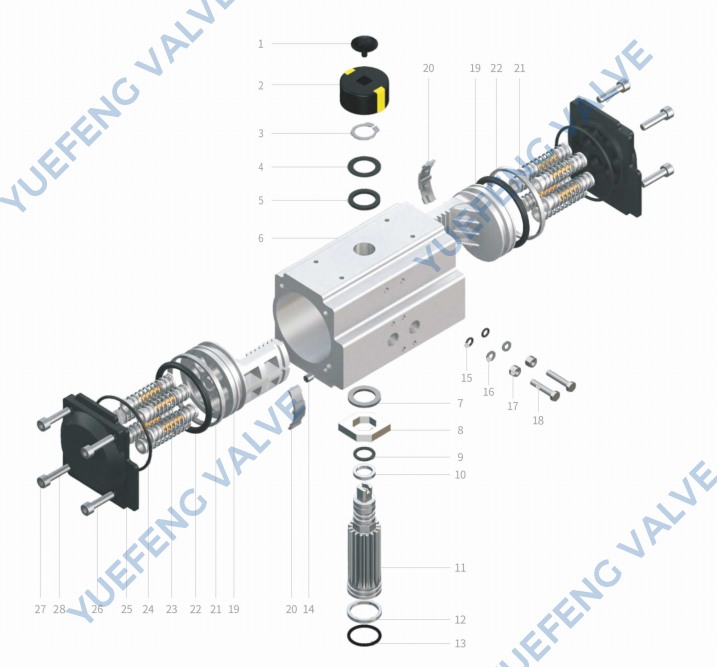
Buyers face multiple design choices when sourcing equipment. Selecting the correct configuration determines your energy consumption, cycle life, and safety profile.
The first major decision involves stroke control and air utilization. Engineers must evaluate whether air pressure should drive motion in one or both directions.
A Single Acting Pneumatic Actuator uses compressed air to drive motion in only one direction. A mechanical spring handles the return stroke. These spring-return models excel in fail-safe applications. If facility power or air supply fails, the spring automatically forces the valve into a designated safe position. You can configure them as fail-open or fail-closed. Additionally, they consume roughly half the compressed air per cycle compared to bi-directional models.
Conversely, a Double Acting Pneumatic Actuator utilizes air pressure for both extension and retraction. It contains no return spring. This design proves ideal for applications demanding maximum bi-directional force. They handle highly rapid cycling because you completely eliminate the risk of mechanical spring fatigue. If your application requires frequent, aggressive switching without strict fail-safe mandates, double-acting units provide superior longevity.
Actuators also divide into distinct categories based on their output motion. You must match the physical trajectory to your specific load.
Linear Cylinders: These push or pull loads in a straight line. Traditional rod-style cylinders handle heavy lifting and pressing. Rodless cylinders move a carriage along their length, saving crucial space in material handling setups. Diaphragm-style linear actuators utilize a flexible membrane instead of a sliding piston. They offer exceptional sensitivity and require zero internal lubrication, making them perfect for highly hygienic Food and Pharma environments.
Rotary Mechanisms: These turn loads across a specified arc, most commonly 90 degrees. A Valve Pneumatic Actuator almost always employs a rotary design.
Within rotary configurations, two specific mechanisms dominate the industrial landscape:
Rack and Pinion: This design uses linear pistons to drive a flat toothed rack against a circular gear (pinion). It remains highly compact and delivers very fast response times. It provides a flat, consistent torque output, making it the standard choice for quarter-turn ball and butterfly valves.
Scotch Yoke: This mechanism features a sliding pin and yoke assembly. It outputs variable torque that mimics a bell curve. It delivers maximum force at the very beginning and very end of the stroke. This perfectly matches the physical opening torque curve of heavy-duty valves. Engineers specify scotch yoke designs for high-friction, severe-service isolation tasks where unseating a stuck valve requires massive initial breakaway force.
Design Type | Motion Output | Ideal Application | Key Constraint |
|---|---|---|---|
Single-Acting (Spring) | One-way air, mechanical return | Fail-safe isolation (ESD valves) | Spring fatigue over millions of cycles |
Double-Acting | Two-way air-driven | High-speed, bi-directional force | Requires fail-safe air reserves if power drops |
Rack and Pinion | Rotary (Quarter-turn) | Standard ball and butterfly valves | Torque remains linear, may struggle with stuck seats |
Scotch Yoke | Rotary (Variable Torque) | Large, heavy-duty severe service valves | Larger physical footprint and heavier housing |
No single technology solves every engineering challenge. To build a trustworthy procurement strategy, you must evaluate solutions objectively. Let us look at where air-driven systems dominate and where they realistically fall short.
Uncompromising Safety: They eliminate spark and ignition risks entirely. Because they lack internal electric motors, they are inherently explosion-proof. This makes them mandatory in volatile chemical plants and refineries.
Power-to-Weight Ratio: They generate exceptionally high force from a surprisingly lightweight footprint. You can mount them on elevated piping without requiring extensive structural support.
Initial Cost & Maintenance: They offer a significantly lower upfront capital expenditure (CapEx) than electric drives. Mechanical repair remains simplified. A technician can swap out a PTFE seal kit in minutes using basic hand tools.
Precision Limits: Air is compressible. Therefore, pneumatic systems cannot match the microscopic positional accuracy of electric servo actuators. If your process requires stopping a load precisely at 42.6% of its stroke, electric drives perform better.
Air Quality Dependency: They remain highly vulnerable to internal corrosion. If the facility compressor delivers air containing excess moisture (condensation), oil bypass, or rust particulates, actuator seals will degrade rapidly.
OpEx Reality: Evaluating Total Cost of Ownership requires absolute transparency. You must include the energy cost of running centralized air compressors. Compressed air is one of the most expensive plant utilities. A poorly maintained system with leaky supply lines will cause operating expenses to skyrocket, negating the low initial CapEx.
Metric | Pneumatic | Electric | Hydraulic |
|---|---|---|---|
Initial CapEx | 5 (Lowest Cost) | 2 (High Cost) | 1 (Highest Cost) |
Long-Term Energy OpEx | 2 (Costly air gen) | 4 (Highly efficient) | 3 (Moderate) |
Positioning Precision | 2 | 5 | 4 |
Explosion-Proof Safety | 5 | 2 (Needs heavy casing) | 4 |
Sizing represents the most critical decision node in the procurement process. Guessing or relying solely on a manufacturer's nominal rating guarantees premature equipment failure.
A common engineering mistake is sizing an actuator based solely on running torque. Valve resistance changes dramatically during a stroke. Buyers must calculate three distinct profiles: Breakaway torque (the force needed to initially crack a closed valve open), Running torque (the friction during mid-stroke travel), and End torque (the force required to securely seat the valve closed).
You must also apply a rigorous safety factor. Standard clean water applications might only require a 20% safety margin above the calculated maximum torque. However, abrasive fluid media, such as mining slurries or dry powders, easily demand safety factors of 50% or more. Undersized units will stall, while continuously over-torquing a system will shear valve stems.
Custom mounting brackets waste time and introduce weak points. Ensure seamless integration by demanding strict adherence to international standards.
ISO 5211 / DIN 3337: This dictates the standardized connection geometry between the actuator drive shaft and the valve stem. Adherence allows you to swap out different actuator brands onto the same valve body without expensive machine shop modifications.
NAMUR: This European standard dictates the mounting interface for external accessories. Specifying NAMUR-compliant equipment ensures you can easily attach standardized solenoid valves, limit switch boxes, and smart positioners directly to the actuator casing.
Ensure your chosen designs meet ISO 4414 guidelines for pneumatic fluid power safety. This standard guarantees the equipment incorporates proper pressure relief mechanisms. It ensures that trapped compressed energy can vent safely during maintenance, preventing explosive depressurization incidents. Reliable emergency cut-off protocols protect both operators and surrounding infrastructure.
Theoretical advantages mean nothing without proven real-world deployment. Air-driven systems dominate several punishing industrial sectors due to their unique resilience.
In the Oil & Gas Sector, volatile and hazardous environments are standard. Facilities rely heavily on these units for Emergency Shutdown Valves (ESD) and Blowout Preventers (BOPs). In these zones, intrinsic safety is non-negotiable. A single spark from an electric motor could ignite ambient fumes. Spring-return pneumatic models ensure that even if a rig loses total electrical power, critical valves snap shut automatically, isolating dangerous pressure zones.
The Mining & Heavy Industry sector presents different challenges. Dust, extreme vibration, and heavy moisture destroy sensitive electronics. Engineers deploy pneumatic mechanisms on knife gate slurry valves and dust suppression nozzles. The robust metallic housings and lack of delicate internal circuitry grant them a high tolerance for severe physical abuse.
Within Automotive Assembly & Robotics, the focus shifts to speed and endurance. Facilities deploy small pneumatic cylinders in end-of-arm tooling, robotic grippers, and automated welding jigs. These setups execute high-speed, repetitive cycling tasks. Because they lack heavy internal copper windings found in electric motors, they weigh much less. This low mass allows robotic arms to move faster and stop quicker. High-quality pneumatic components easily outperform heavier electric alternatives across millions of rapid cycles.
Choosing the right pneumatic actuator requires looking far beyond the specific device. Your ultimate success depends heavily on surrounding facility infrastructure. The efficiency of your control loops and the cleanliness of your compressed air system dictate performance just as much as the actuator itself. Evaluate your precision needs and safety requirements before committing to a technology.
As a next step, procurement teams should actively shortlist vendors who operate with high transparency. Demand clear torque curve data rather than vague maximum ratings. Ensure all quotes strictly adhere to ISO 5211 and NAMUR mounting standards. Finally, prioritize manufacturers who offer robust aftermarket support, ensuring rapid access to replacement seal kits and modern predictive maintenance sensors.
A: Most industrial pneumatic systems operate reliably between 4 to 8 bar (roughly 60 to 120 psi). Standard facilities usually regulate their instrument air to around 80 psi to balance power output with compressor energy efficiency. However, highly specialized heavy-duty applications can require custom high-pressure setups exceeding these typical ranges.
A: The leading cause is poor air quality. Moisture condensation and oil bypass from compressors wash away internal factory lubrication, causing severe piston ring and rack wear. Additionally, improper sizing leads to continuous over-torquing, which physically degrades internal seals, bearings, and drive shafts long before their rated lifespan.
A: With exceptionally clean, regulated instrument air and a scheduled preventive maintenance program, top-tier actuators exhibit remarkable longevity. Depending on the physical load, cycle speed, and environmental harshness, a well-maintained unit can easily exceed 10 to 50 million cycles before requiring a complete overhaul.


