

close
Choose Your Site
Global
Social Media
Views: 0 Author: Site Editor Publish Time: 2026-04-30 Origin: Site


A Pneumatic Actuator operates far beyond a simple mechanical component. It stands as a critical node in industrial automation, converting compressed gas into high-density mechanical force. While these devices boast unmatched power-to-weight ratios and explosion-proof safety profiles, specifying the wrong unit invites trouble. Miscalculating the hidden costs of pneumatic infrastructure often leads to inefficient air consumption, regulatory compliance issues, and sudden process failures. Plant managers frequently underestimate the system-wide demands these devices place on air compressors. This article serves as a comprehensive technical and commercial guide to evaluating your automation needs. We will explore how to specify the right unit, calculate the true total cost of ownership, and align your configurations with strict industrial safety standards. You will learn actionable frameworks to secure reliability across your flow-control network.
High Power Density: Pneumatic systems natively decouple thrust from speed, allowing for simultaneous high-speed and high-force operations that electric alternatives struggle to match.
Failsafe Criticality: Choosing between spring-return (single-acting) and air-return (double-acting) mechanisms dictates your system's emergency shutdown (ESD) capabilities.
Standardization: Industrial applications typically rely on standard control signals (3–15 psi or 20–100 kPa) and conform to dimensional standards like ISO 15552 or NFPA.
To fully leverage pneumatic power, you must understand the underlying physics. The power conversion mechanism relies entirely on differential pressure. Compressed air enters a sealed cylinder, pressing against a piston, vane, or flexible diaphragm. The opposing side typically vents to the atmosphere. This creates a pressure imbalance. The resulting force drives the internal mechanism forward. Standard industrial environments maintain an operating pressure baseline between 4 and 8 bar (approximately 80 to 100 psi). At these pressures, even a compact cylinder can generate tremendous mechanical thrust.
Modern automation depends on precise signal flow and control. Rarely do you manually open an air valve to actuate a process line. Instead, facility Programmable Logic Controllers (PLCs) govern the movement. The standard workflow operates as follows:
The facility PLC outputs a standard 4–20 mA electrical current.
An I/P (Current-to-Pressure) converter receives this electrical signal.
The converter translates the current into a proportional 3–15 psi pneumatic control signal.
This pneumatic signal modulates the main air supply entering the actuator.
One primary reason engineers choose pneumatics over electricity is the unique "thrust versus speed" advantage. Electric motors face a fundamental physics limitation. High thrust requires significant gear reduction, which destroys your actuation speed. Pneumatic systems bypass this limitation entirely. You can achieve rapid actuation times without compromising output force. If a process demands more speed or thrust, you simply size up the cylinder bore or increase the air supply flow rate. The mechanism naturally decouples force from velocity.
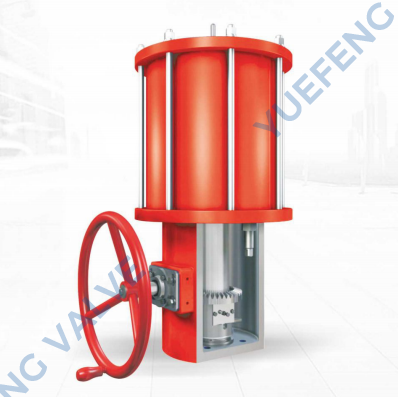
Selecting the correct Valve Pneumatic Actuator requires aligning the internal geometry with your specific process control application. Industrial flow control relies on two fundamental motion types: linear and rotary.
Linear actuators utilize diaphragms or pistons to push and pull in a straight line. Engineers map these devices to multi-turn or linear valves, such as gate, globe, and pinch valves. A diaphragm mechanism performs exceptionally well in extreme temperature zones and high-vibration environments. Since they lack sliding O-ring friction, diaphragms offer superior longevity for short-stroke applications.
Rotary actuators dominate the quarter-turn valve market. They operate ball, butterfly, and plug valves. Inside the housing, a rack-and-pinion or vane mechanism converts the linear push of a piston into rotational torque. The industry considers rack-and-pinion the standard for its consistent torque delivery throughout the entire stroke.
Buyers must always verify compliance against international specification standards. Do not purchase proprietary form factors. Rely on benchmarked dimensions to ensure future interoperability. For compact spaces, seek ISO 6432 compliance. For heavy-duty industrial tasks, demand ISO 15552 or NFPA tie-rod standards. Following these standards guarantees you can source replacement parts globally.
Environmental matching poses another major implementation risk. You cannot place a standard aluminum housing in a niche environment and expect survival. Oil and gas facilities demand corrosion-resistant housings (often 316 stainless steel) and explosion-proof certifications. Conversely, the food and beverage sector requires sanitary washdown ratings, smooth exterior geometries, and FDA-approved internal lubricants.
Actuator Geometry | Mechanism Type | Compatible Valves | Ideal Environment / Application |
|---|---|---|---|
Linear | Diaphragm / Piston | Gate, Globe, Pinch | High vibration, extreme temperatures |
Rotary | Rack & Pinion | Ball, Butterfly, Plug | Consistent torque, quarter-turn process control |
Rotary | Scotch Yoke | Large Ball, Large Butterfly | Heavy duty, high breakaway torque needs |
Process safety relies heavily on how equipment responds during power failures or compressor trips. Engineers must choose between two primary operational modes to dictate emergency shutdown capabilities.
A Single Acting Pneumatic Actuator uses air pressure to move the mechanism in one direction. To return to the baseline position, it relies on an internal mechanical spring. This setup serves as the backbone of industrial fail-safe configurations.
Implementation realities make this design crucial. Engineers specifically configure these units as either "Fail-Open" or "Fail-Closed" to prevent catastrophic events during total power or air loss. For example, in offshore oil drilling, a blowout preventer (BOP) must instantly slam shut if the rig loses main power. A heavy-duty spring-return mechanism guarantees this closure without requiring external energy.
However, you must accept distinct trade-offs. Internal springs constantly fight against the incoming air pressure. This reduces the overall output force available for your process. Additionally, housing a heavy industrial spring significantly increases the physical footprint and weight of the unit.
A Double Acting Pneumatic Actuator utilizes compressed air to drive both the extension and retraction strokes. It contains no internal return spring.
In implementation, this mechanism delivers superior performance metrics. You get maximum output force because no spring resists the air pressure. Cycle times drop significantly, allowing for high-speed automated sorting or assembly. Because it lacks a spring cartridge, the unit maintains a highly compact footprint.
The core trade-off involves emergency safety. This design lacks a native mechanical failsafe. If facility air drops abruptly, the actuator remains locked in its last known position. To create a failsafe environment, operators must install supplemental volume tanks and complex switching valves, which complicates the piping layout.
When upgrading facility automation, procurement teams often fall into the initial price trap. A bare pneumatic device costs significantly less than a comparable electric unit equipped with precision planetary gearing. It also features incredible durability. However, assessing the actual financial impact requires calculating the System-Level Total Cost of Ownership.
Pneumatics only remain cost-effective if deployed at scale within a facility featuring existing, optimized air compressor capacity. If you buy a cheap air cylinder but must install a new compressor to run it, your ROI vanishes instantly.
Hidden costs accumulate rapidly. You must run dedicated air lines to the installation site. Compressors consume massive amounts of electricity. You also need to install FRL (Filter, Regulator, Lubricator) units at each drop point to protect the equipment. Furthermore, system-wide air leaks represent a massive financial drain. A single 1/4-inch leak in a 100-psi system can cost thousands of dollars annually in wasted electricity. Unused or inefficient compressor capacity destroys the economic advantage of pneumatic automation.
Cost / Feature Factor | Pneumatic Actuators | Electric Actuators |
|---|---|---|
Initial Hardware Cost | Very Low | High (Motor + Gearing) |
Infrastructure Needs | High (Compressors, Lines, FRLs) | Low (Standard Wiring) |
Maintenance Burden | High (Leak checks, seal replacements) | Low (Self-contained lubrication) |
Energy Efficiency | Low (Compressor losses) | High (Power only used during movement) |
You must also consider precision and automation limits. Electric drives achieve micro-inch positioning natively through encoders. Pneumatics struggle to hold intermediate positions. To achieve proportional control, you must install expensive digital positioners. This adds cost and complicates system programming.
Finally, emissions and ESG (Environmental, Social, and Governance) considerations matter. Environmental regulations continue tightening globally. Vented air from pneumatic exhaust ports can carry oil mist or process gases into the atmosphere. Electric systems remain entirely zero-emission at the point of use, making them highly attractive for green facility initiatives.
The number one failure mode in pneumatic systems stems directly from poor air quality. Your equipment exhibits total dependency on clean, dry air. Condensation frequently builds up inside poorly managed air lines. When water enters the cylinder housing, it washes away factory-applied lithium lubrication. Without lubrication, internal friction spikes. This quickly leads to torn piston seals, scored cylinder walls, and aggressive rack wear.
Facility managers must set realistic expectations regarding upkeep. You cannot install these devices and forget them. We strongly recommend implementing a strict preventative maintenance program.
Inspect Flexible Diaphragms: Check for micro-tears or brittle rubber caused by extreme temperature cycling.
Leak-Test Cylinder Seals: Use ultrasonic leak detectors around end-caps and output shafts to identify compromised O-rings.
Monitor Air Preparation: Regularly drain water traps on your FRL units and refill the lubricator reservoirs.
Verify I/P Calibration: Ensure your Current-to-Pressure converters accurately map the 4-20mA signal to the correct 3-15 psi output.
To avoid costly procurement mistakes, engineers should follow a strict shortlisting logic. Work through this four-step framework before issuing any purchase orders:
Calculate the required breakaway torque (the force needed to unseat the valve) and the running torque (the force needed to keep it moving).
Determine the available, sustained facility air pressure at the specific installation point, factoring in pressure drops over long pipe runs.
Define your strict failsafe requirements to decide between spring-return or double-acting mechanisms.
Assess integration protocols with current PLC and automation networks to ensure communication compatibility.
Pneumatic actuators remain the gold standard for high-force, hazardous-environment valve control. Their intrinsic safety, rapid cycle times, and robust durability make them indispensable across heavy industries. However, their true value emerges only when the surrounding facility infrastructure fully supports their operational demands. A cheap device installed on an inefficient air network quickly becomes a financial liability.
We encourage buyers to transition from conceptual evaluation directly into precise sizing calculations. Do not rely on guesswork. Your next step should involve consulting a flow-control engineer to analyze your line pressure and torque requirements. Download a specific Actuator Sizing and Torque Calculation Matrix from your manufacturer to avoid undersizing your components and risking process failures.
A: When supplied with clean, dry, and properly lubricated air, high-quality industrial units easily exceed millions of operational cycles. Lifespan depends heavily on air quality. Condensation or particulate contamination can ruin internal seals in just a few months, drastically shortening the equipment's expected lifecycle.
A: Yes, in many modern designs. Many manufacturers utilize modular rack-and-pinion architectures. Technicians can remove the end caps and insert modular spring cartridges. This process quickly converts a standard double-acting unit into a spring-return, failsafe mechanism without requiring an entirely new housing.
A: Slow actuation usually indicates air flow restrictions rather than mechanical failure. Common culprits include clogged exhaust port mufflers, undersized supply air lines, or a significant air pressure drop across the facility. Always verify your supply pressure directly at the actuator inlet during operation.


